Gates of Hades is a genuinely different game, not a recoloured Olympus. Olympus, Valhalla, Aztec and Olympus 1000 all share the 6x5 pay-anywhere engine. Hades runs a 6x6 grid with cluster pays, so the board is bigger and the win rule is fundamentally different. One independent reviewer called it "a fresh spin on the familiar Olympus formula, not a clone," and after running both we agree. The shared DNA is the tumble mechanic, the Greek theme and the swingy, feature-driven feel. The engine underneath is not the same.
Reviewed game
 Gates of Hades (Pragmatic Play)
Play the game
18+ | T&C apply | Play responsibly
Gates of Hades and Gates of Olympus share a family name but play differently: Hades is 6x6 cluster pays with per-reel wild multipliers and a 10,000x ceiling; Olympus is 6x5 pay-anywhere with multiplier orbs and 5,000x. Here is the full side-by-side.
Which one should you actually play
Play Gates of Hades if you want a 6x6 cluster-pays grid with a 10,000x ceiling and per-column wild meters that stack. Play Gates of Olympus if you prefer the classic 6x5 pay-anywhere game where multiplier orbs sum the whole win and the ceiling is 5,000x. Olympus runs high volatility while Hades is rated medium, both are Pragmatic Play, and both sit near 96.5% RTP on their default models. So the decision isn't about which is "better." It's about which win engine you enjoy watching.
Here's the short version from our own testing. We loaded both demos back to back on virtual credits and ran roughly 200 spins each. Hades feels colder and spikier, because wins only form from 5 or more connected symbols and the column meters clear between base spins, so dead stretches are common. Olympus drips more often, because 8 scattered symbols anywhere pays and small clusters of orbs land regularly, but its top end is half of what Hades can reach. Neither is generous in the base game. They both live or die in free spins.
If you skim nothing else, read the table below. It's the whole comparison in one screen.
Hades vs Olympus: the full table
The two games differ on grid, win rule, multiplier model and ceiling, everything except provider and volatility class. This is the spec sheet we built from each game's paytable and Pragmatic Play's published figures, verified once in each demo.
| Spec | Gates of Hades | Gates of Olympus |
|---|---|---|
| Grid | 6x6 | 6x5 |
| Win mechanic | Cluster Pays + Tumble | Pay-anywhere (scatter pays) + Tumble |
| Win rule | 5+ connected matching symbols | 8+ matching symbols anywhere |
| Multiplier model | Per-column wild meter that sums and persists in free spins | Multiplier orbs that sum the whole win on a tumble |
| Scatters to free spins | 3+ scatters (10/12/15 spins), 6+ triggers 20-spin Super Free Spins | 4+ scatters, 15 spins |
| Max win | 10,000x | 5,000x |
| Volatility | Medium (3/5) | High (5/5) |
| Theme | Greek underworld, Hades and Cerberus | Mount Olympus, Zeus |
| Default RTP | 96.52% | 96.50% |
| Feature buy | 100x / 500x (banned in the UK) | ~100x (banned in the UK) |
| Online release | 22 May 2025 | Feb 2021 |
Two rows carry most of the story: the multiplier model and the max win. Everything else is close enough that it won't change your session much.
The differences that matter
The three real differences are the win rule, the multiplier model, and the ceiling. Grid size and theme are cosmetic next to these.
Start with the win rule, because it changes how a spin feels. Olympus doesn't care where symbols land. Get 8 matching gems or fruits anywhere on the 6x5 grid and you're paid, which is why small wins arrive often. Hades is stricter. Its symbols must form a cluster of 5 or more that touch each other horizontally or vertically on the 6x6 board, so a screen full of the same symbol scattered across corners pays nothing. Our guide to how the cluster pays work covers that rule in full. That single rule makes Hades quieter between features and more binary when a feature does hit.
The multiplier model is the deeper split, and it's where people wrongly assume the two games are the same. In Olympus, multiplier orbs drop randomly, and at the end of a tumble sequence every orb on screen adds up and multiplies your total win once. In Hades, each wild carries a multiplier that gets collected into a meter above its own column, the values in that column add together, and the column total applies to any winning cluster touching that reel, on every tumble. So Hades rewards you for stacking meters in the same columns where clusters keep forming, while Olympus rewards you for simply having orbs on the board when the dust settles. Different puzzle, different rhythm.
Then the ceiling. Hades tops out at 10,000x your bet, double the 5,000x Olympus can pay. That gap exists because Hades wilds can climb to x500 in free spins and their column meters persist for the whole feature, compounding across every tumble. We lay out how the 10,000x is actually reached and the odds on its own page. Olympus resets its orb tally each spin, so it can't build the same runaway tower.
In one 200-spin Hades demo run, the best we hit was a cluster of crowns landing on a column that had quietly stacked to x64. It paid a little over 300x. Good, not life-changing, and it took most of the session to arrive. Our Olympus demo gave up more frequent 20x-40x hits but never threatened the same top number. That matches what the maths says: bigger swings on Hades, steadier drips on Olympus.
No, Hades is not a reskin of Olympus
Three names people mix up
Search results blur three separate Pragmatic Play products. Here's which is which, so you don't launch the wrong game.
Gates of Hades
The game this site reviews. A 6x6 cluster-pays underworld slot with per-column wild meters, a Super Free Spins mode and a 10,000x ceiling. Released 22 May 2025.
Super Scatter confusion
Hades has a Super Free Spins mode, triggered by 6+ scatters, where every wild multiplier is a minimum x10. It does not have a "Super Scatter" symbol. The Super Scatter belongs to a different game, Gates of Olympus Super Scatter, released 28 April 2025. If you searched "gates of hades super scatter," you probably want Super Free Spins.
Gates vs Hades: Gods of War 250
Yet another separate Pragmatic Play title, not this slot and not Olympus. If a casino lists it, treat it as its own game with its own maths. Don't assume it shares Hades' 10,000x ceiling or cluster mechanic.
What each free-spins mode felt like
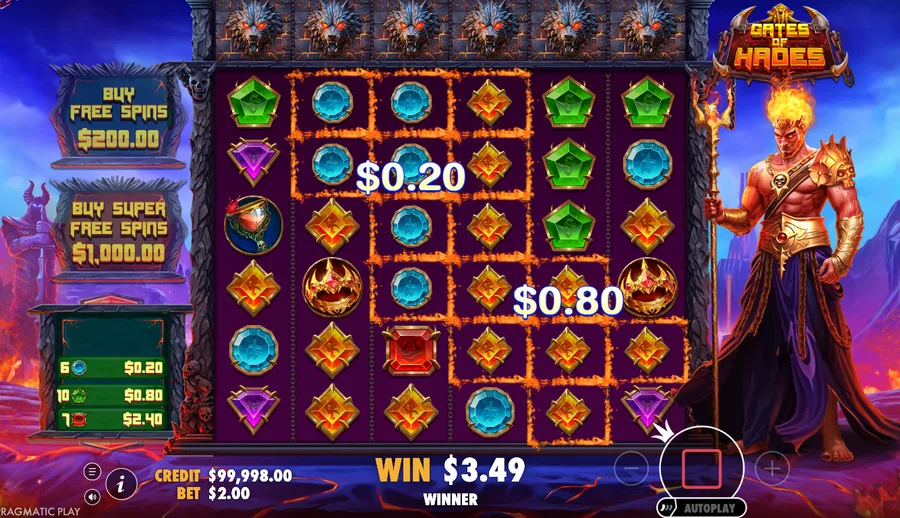
Both games front-load their payout into free spins, so that's where we spent most of the two demo sessions.
Hades free spins persist the column meters, which is the whole point. Once a meter climbs, it stays up for every remaining spin, and a good run turns a modest cluster into a large one because the column total keeps multiplying. When it clicks, it climbs fast. When the scatters won't drop, you can sit through long dry stretches. We triggered the regular 10-spin round twice in about 200 base spins and never once opened the 20-spin Super round without buying it.
Olympus free spins are simpler. Fifteen spins, orbs land, multipliers accumulate for the whole feature, and the total climbs steadily rather than in the spiky bursts Hades produces. It's the friendlier of the two to watch, though it can't reach as high.
Our demo numbers, side by side
These are the measurements we logged running each demo for roughly 200 spins at matched stakes on virtual credits. Small sample, so read them as texture, not proof. Two 200-spin runs can't estimate a 1-in-42-million event.
| Metric | Gates of Hades (demo) | Gates of Olympus (demo) |
|---|---|---|
| Spins logged | ~200 | ~200 |
| Free spins triggered naturally | 2 | 3 |
| Biggest single win | ~300x | ~110x |
| Typical small win | 2x-8x | 1x-5x |
| Longest dead streak | ~18 spins | ~11 spins |
| Demo balance shown | $1,000 | $1,000 |
The pattern held both directions: Hades hit harder and less often, Olympus hit softer and more often. That's exactly the trade the two designs describe on paper, and it's the clearest way to decide between them. Want to feel it yourself before risking money? Load the free Gates of Hades demo and run your own 200 spins.
Pick Hades if
You chase the big number, you can stomach cold stretches, and the idea of a column meter stacking to x500 in a persistent free-spins run is what keeps you spinning. The 10,000x ceiling and cluster puzzle are the draw. Bring patience and a bankroll that survives the dry runs.
Pick Olympus if
You want the more familiar rhythm, more frequent small hits, and a game that's easier to follow at a glance. The 5,000x cap is lower, but the ride is smoother and the pay-anywhere rule is more forgiving. It's the gentler of the two, high volatility notwithstanding.
Where both games fall short
Neither slot is a slam dunk, and the comparison cuts both ways.
Hades punishes you between features. The 5-plus-connected rule means whole screens can pay nothing, hit frequency sits around 29% (reported by aggregators, not official), and the natural free-spins trigger is roughly 1 in 270 spins, so you can grind a long time to see the good stuff. Its 10,000x ceiling is real but the max-win probability is about 1 in 42,194,093, a lottery ticket, honestly. And the operator RTP can be set to 95.47% or 94.47% instead of 96.52%, which you rarely get to check.
Olympus has the opposite problem: it's everywhere, it's familiar, and its 5,000x ceiling is half of Hades'. If you've played it for years, Hades' bigger top end is the main reason to switch, though you'll trade away the steadier flow to get it. We don't recommend jumping to Hades expecting Olympus' pace. You'll be disappointed by the silence.
One shared watch-out: the feature buy (100x or 500x on Hades) is stripped for UK accounts under Gambling Commission rules, so the game loads without a buy button there. Don't count on buying your way into the good round if you're playing from the UK.
Our verdict on the matchup
If you already love Olympus and want more of the same, stay put, because Hades will feel harsh. If you want a higher ceiling and a fresh puzzle and you can handle the volatility, Hades earns the switch. We score Gates of Hades 7.3/10 as a game, and against Olympus it wins on ambition and loses on comfort. You're choosing between a bigger swing and a smoother ride, not between good and bad.
Our honest steer: try both demos first. Run 100 spins on each and you'll know within ten minutes which rhythm you actually enjoy, before a single dollar is at risk. When you're ready to play for real, search the lobby for Pragmatic Play titles; availability varies by region and operator. You can check the current welcome offer at 1Win, compare both operators on our where to play for real money hub, or line Hades up against the other games on our similar slots shortlist.
Common questions
Is Gates of Hades just Gates of Olympus reskinned?
No. Hades is a 6x6 cluster-pays game; Olympus is a 6x5 pay-anywhere game. Different grid, different win rule, different multiplier model.
Which has the bigger max win?
Gates of Hades, at 10,000x the bet. Gates of Olympus caps at 5,000x, half of Hades' ceiling.
Does Gates of Hades have a Super Scatter?
No. Hades has a Super Free Spins mode from 6+ scatters. The Super Scatter feature belongs to a separate game, Gates of Olympus Super Scatter.
What is "Gates vs Hades: Gods of War 250"?
A different Pragmatic Play title entirely, not this slot and not Olympus. Treat it as its own game with its own maths.
Which one is less volatile?
Neither, officially. Hades is rated medium volatility (3/5), Olympus high (5/5). In our demos Olympus paid small wins more often, but its swings are still large.
How do we test these games?
We loaded each free demo, ran roughly 200 spins at matched stakes, logged the wins and streaks, and read each paytable against Pragmatic Play's published figures.
Sources
- Pragmatic Play official game page: confirms the 6x6 grid, cluster mechanic and 10,000x max win.
- Pragmatic Play press release: confirms the 22 May 2025 release and the Greek Gods series lineage.
- UK Gambling Commission: the regulator behind the UK feature-buy ban that strips the buy button.